TL;DR
A branded holiday bar offered me $300.00 for opening-night photography. At first glance, $300.00 for 3 hours of work seems pretty good. However, once I took a breath and considered what it actually costs, my profit margins disappeared into real expenses, before I’d paid myself for a minute of work. Meanwhile, if the organizer wanted to use even one of those photos in a paid campaign to sell tickets, that license alone could be worth thousands. The offer priced the photography like a minor expense while leaving its commercial use out of the conversation entirely. A serious budget has to account for both what it costs to make the images and what the images are worth to the business based on the expected job they will do. In this case, they would be doing a lot of the heavy lifting this season, and likely seasons to come.
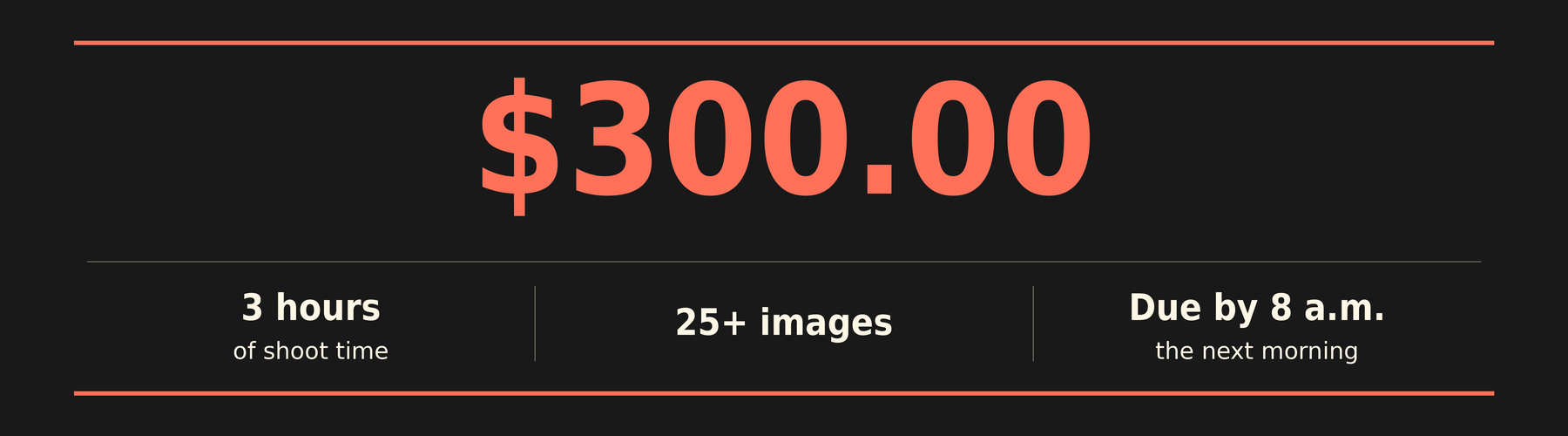
Recently, I received an inquiry to photograph the opening of an extremely recognizable, branded seasonal bar. Three hours of coverage. At least 25 high-resolution photographs, in vertical and horizontal formats. Delivery by eight the following morning. The offer was $300.00. Here’s the email, with redactions.
Hi team,
Marta here from (Redacted), saw your work on Instagram and wanted to reach out!
We're looking for a photographer to help capture some photos at the new (Redacted) Holiday Bar opening night in Atlanta on November 18. Let me know if you'd be avail / interested + any questions I can answer. Sharing more details below.
Date & Time: November 18 ~5:30PM - 8:30PM
Location: Pullman Yards, 225 Rogers St NE, Atlanta, GA 30317,
Deliverables:
- 25+ Hi-Res photos (mix of vertical and landscape)
- Turn around by 8am the following morning
Rate: $300
Best,
What hit me first was the assumption built into the approach. Someone comes to a professional business, lists everything they need, sets an overnight deadline, and presents $300.00 as though the conversation about what the assignment costs has already happened. Here is the scope. Here is the budget. Make it work. A quick yes doesn't make a simple job. The conversation about preparation, editing, delivery, and usage is where you establish what you're actually agreeing to provide. Skipping all of that makes accepting the offer feel easy while leaving the photographer to resolve the complicated parts inside a price that's already been set.
The more I considered what that number was supposed to cover, the more insulting it became. This was photography for a commercial experience, a space people would discover through publicity and promotion, pay to enter, and spend more money inside.
Let's put that offer beside the work, the investment, and the possible uses of the photographs. The assignment and my own pricing are real. The production, rent, attendance, and spending scenarios below are drawn from comparisons. The advertising section also draws on published licensing examples. We're examining the economics of a proposition with the figures available to us.
The money to create the experience
This type of attraction involves an actual production process. In researching comparable installations, I found a production company's case study for four branded holiday bars describing design concepts, mockups, décor sourcing, site evaluations, vendor coordination, labor teams, and installation supervision.
Imagine three possible production budgets of $10,000, $25,000, or $50,000. The $300.00 photography fee represents 3%, 1.2%, or 0.6%, respectively.
Take a $5,000 decorator as one component of that budget. Someone has to choose the materials, arrange the space, create the atmosphere, and make the experience desirable. Designers, fabricators, installers, and lighting suppliers may all contribute. Their work has a purpose, and it deserves to be paid. So does translating that work into photographs that make someone want to buy a ticket. Why invest in a room designed to attract attention and then treat the person creating its promotional images as an afterthought?
Five thousand dollars to make the room compelling. Three hundred to photograph the result and persuade people to visit.
We don't know what space is being contracted for this event, so we can't calculate the exact square footage of the space at Pullman Yards. However, I have a direct comparison to a space here in Peachtree City. A busy restaurant in a prominent part of town leases a roughly 8,000-square-foot building for roughly $30,000.00 per month. Short-term arrangements and fitted restaurant spaces may have different economics. For this thought experiment, let's use a low estimate of $12,000 a month in rent. The $300 photography offer is 2.5% of that one expense. Utilities, staffing, insurance, inventory, and the production itself are still separate obligations.
In this hypothetical budget, thousands are committed to occupying a space, and customers are needed to justify that commitment. Twelve thousand dollars to have the room. Three hundred for the opening photographs expected to help put people in it.
The money the experience could bring in
They’ve already started selling tickets. Prices start at $25.65 for a 90-minute visit including a welcome cocktail. There are roughly 10 time slots that turn over every night. Let's round down again and use $25 admission in our scenario. Even if they limited the number of guests to 20 per time slot, that would come out to roughly 200 guests per night. At $25 each, that's $5,000 in ticket sales per night. Repeat that for 30 nights and you have $150,000 in gross revenue just in admission.
Now give each guest a further $25 in food or drinks beyond the included cocktail. That's another $150,000 over the month, bringing the combined gross to $300,000. Again, we're assuming 200 customers nightly, without adding add-ons, brunch, or merchandise sales. The photography offer is now 0.1% of that hypothetical gross. Those photographs will absolutely be part of the effort to attract the customers whose spending makes the operation work.
Keep the same attendance and $25 admission, but change the additional spending per person. At $50, total monthly gross becomes $450,000. At $100, it becomes $750,000. Then the photography budget is 0.04% of that hypothetical gross revenue.
Those scenarios use different amounts of spending per person to show how a commercial attraction can make money from the same visit. Admissions, additional drinks, food, merchandise, and private events can all matter.
A well-produced set of photographs can help communicate several of those offerings. Show the atmosphere, the drinks, the details, and people enjoying themselves, and you give the marketing team material to work with throughout the run.
As the possible revenue grows, the photographer's offered fee stays fixed at $300. The business wants images capable of supporting a substantial sales effort while pricing their creation like a minor errand.
The cost of actually delivering the photographs
Let's now consider what it takes to actually produce these photos. Start with an hour driving there and an hour driving home. Add three hours photographing the event and then an additional two hours selecting, editing, exporting, and delivering the images. That's seven hours. Three hundred divided by seven is $42.86 an hour before a single expense or tax.
That still leaves out the initial correspondence, planning, equipment checks, charging, packing, and backups. It also assumes that selecting and finishing at least 25 photographs from an opening-night event takes only two hours... after a full shoot day and getting home late. Every additional hour lowers the return.
Someone looking at the offer might see $100 an hour and think they've landed something worthwhile. That number disappears as soon as you count the whole assignment. You're running a business, and your take-home pay comes after business expenses and taxes.
Imagine that a kit with two bodies, two lenses, a hot shoe flash, and possibly a tripod cost you $300 to $400 to rent for this assignment. At $300, the whole fee goes to equipment. At $400, you're already $100 in the hole before transportation or paying yourself anything.
Owning the kit changes when you paid for it. You still have to account for the purchase, maintenance, replacement, and insurance. Backup equipment is another investment you carry because a client expects usable photographs even if a camera fails. Add your computer, editing software, storage, and delivery system. None of them runs on compliments. For example, my bare-bones kit described above is roughly $10,000.00. If you add my computer and software, that is another $5,000.00.
The buyer wants the reliability of a professional operation while offering a sum that, in the rental scenario, barely covers getting the necessary equipment into your hands. Three hundred dollars isn't magically sufficient because you already own the tools.
The deadline has a price, too
My real commercial fee for rush delivery within 48 hours is $250 per image. Twenty-five images at that rate is $6,250 in expedited-delivery fees alone. Granted, this is not typically added to event work. If the event client wants a 24-hour turnaround, that typically covers a social media wrap-up. Depending on the package, it's either billed separately or included in the overall estimated fee.
This request called for delivery the next morning. Shoot until approximately 8:30 p.m., get home, process the assignment, and have the files ready by 8 a.m. That's an overnight commitment with an eleven-and-a-half-hour window after coverage ends.
But why do they need the photos at 8:00 a.m.?
The photographs keep working after the photographer goes home
The photographs don't necessarily stop working when opening night ends. These are specifically being commissioned for PR usage. The email leaves that unstated, but I recognize it from experience. The client needs rush delivery in order for local editorial coverage to pick up the story and start the marketing push to sell more tickets.
Now imagine using them to launch next year's event... Actually, you can look at the website already and see that's exactly what they are doing. There is also likely a July-through-December campaign across Facebook and Instagram, plus magazine advertisements in the cities where the experience operates. The same photographs could help sell a new season of tickets long after the photographer has been paid.
In a 2013 case study, Wonderful Machine described an awarded hospitality assignment for an international hotel chain. The license covered one year of U.S. advertising, collateral, and publicity use, with the campaign built around web and print advertisements. The lead photograph was priced at $10,000. Two additional primary photographs were $5,000 each. Supporting photographs ranged from $500 to $2,000 each, bringing the total licensing fee for 17 images to $34,000. Production expenses were listed separately. A Photo Editor’s hotel advertising case study
That historical assignment shows how an image used to sell a hospitality experience can have substantial commercial value beyond the hours required to make it.
For a separate print-only comparison, Brian Adams PhotoGraphics lists $5,000 per image for one year of national print or magazine advertising. The schedule is undated. Add paid digital advertising to a print-only license and you're asking for broader rights, which belong in the negotiation. The Wonderful Machine example already includes both web and print. Brian Adams PhotoGraphics’ licensing schedule
Put $300 beside those figures. It's 6% of the $5,000 print-only license. It's 3% of the hotel campaign's $10,000 lead-image fee. Both comparisons concern one photograph. The inquiry asked me to create at least 25 and deliver them overnight.
The original inquiry left advertising rights open. If the expectation is six months of paid promotion, that needs to be priced. If the expectation is unlimited reuse across future seasons and locations, the request is broader still. Both expectations deserve an explicit conversation before anyone agrees on a fee.
We have documented examples of thousands of dollars for the use of one advertising photograph. Against that, $300 for creating 25 images, delivering them overnight, and potentially supplying future campaigns is a grotesque mismatch. How much commercial value is the photographer supposed to hand over before somebody admits the offer is absurd?
Creative expertise comes with accountability
A “quick opportunity” can carry an enormous amount of unspoken business, from production and overnight delivery to publicity, paid advertising, and future reuse. Put one small fee at the top and leave those details out, and a photographer can end up agreeing to a much bigger assignment than the pitch acknowledges. The tactic is to make the opportunity sound casual while the commercial expectations remain substantial. A photographer can be excellent at making pictures and inexperienced at negotiating their use. When an agency exploits that gap to get a discount, calling it an opportunity is part of the pitch.
A company that sells creative expertise is accountable for how it purchases creative labor. Treating creative partners as disposable and calling the resulting $300.00 offer an opportunity is a failure of professional judgment.
Being contacted out of the blue can feel like being chosen. Someone you weren't expecting shows up in your inbox, and before you've even evaluated the assignment, you think, They found me. Maybe they like my work. Maybe this leads somewhere. Even an impersonal inquiry can make a terrible offer feel worth considering.
That's the emotional advantage a pitch like this can have. You start supplying your own reasons to accept it. It could build your portfolio, put a recognizable client on your list, or get you another booking next year. Whether the buyer deliberately encourages that feeling or simply benefits from it, you're the one paying for those possibilities through the discount you give today.
An inquiry isn't a compliment you owe someone a discount for.
I took offers like this for years. I told myself I was building my book, building a client base, getting a foot in the door. Do a good job now, and they'd come back. Next time the budget would be bigger. The discount would be an investment in a relationship.
That's never how it works. The person I worked with would leave, and the next person would find someone else. Or the pressure would be to make the next job cheaper. Having accepted the rate once became a reason to expect it again, sometimes with another cut. The discount became the baseline.
That's part of why this makes me angry. I understand why someone would see $300 and convince themselves that the real payoff is coming later. I made that bet myself. The repeat booking, the bigger budget, and the lasting relationship were all hypothetical. My time, my expenses, and the work I delivered were real. And here's what no one wants you to understand. They were EXTREMELY VALUABLE.
Don't price today's work around a better-paying assignment nobody has committed to giving you.
We've put $300.00 beside the investment in the space, the potential ticket and bar revenue, the equipment and labor, the overnight deadline, and the commercial use of the finished images. Every comparison exposes another cost or another source of value that the offer expects the photographer to swallow. Someone may still take it. You can quote a sustainable price, negotiate a smaller assignment and narrower usage, or simply say no. You get to decide what your business needs to charge when someone else treats photography as a rounding error. They want your work to help make their business profitable. You are allowed to insist that doing the work makes yours profitable as well.