TL;DR:
If you’re building an event photography kit on a budget, start with a reliable camera and a 24–70mm zoom. That combination covers group portraits, important guests, room details, and most of the moments clients specifically ask for. Add a 70–200mm lens and a second body when you need more reach and the ability to react without changing lenses. My approach is straightforward: carry the equipment that lets you respond to unpredictable moments while remaining as unobtrusive as possible.
An experienced corporate event photographer’s approach to cameras, lenses, lighting, and capturing important moments without disrupting the event.
Most corporate events don’t call for a complicated equipment setup. They call for the ability to respond quickly, work in difficult light, and photograph people without interrupting what’s happening.
After years of covering corporate gatherings, conferences, and keynote presentations, I’ve settled on a deliberately simple kit: two Nikon camera bodies, two zoom lenses, one on-camera flash, and a dual-camera harness.

The Primary Camera: Nikon Z6III and 24–70mm Lens
My primary camera is the Nikon Z6III, fitted with a 24–70mm lens and a Godox V1 Flash for Nikon. This is the camera I reach for when I’m interacting directly with guests. It handles small groups, posed photographs of executives or other notable attendees, and the spontaneous requests that happen constantly at corporate events. The flash gives me another way to work with whatever light the venue provides. Sometimes I bounce it off a suitable ceiling. Other times, I aim it toward the subject, depending on whether I need fill light or a stronger primary source. There’s no single lighting arrangement that works in every corner of the room.
The Second Camera: Nikon Z6II and 70–200mm Lens
My second camera is the Nikon Z6II with a 70–200mm lens. I use it without flash, generally wide open at f/2.8, relying on ambient or stage lighting and raising ISO when necessary. Around 105–200mm, I can photograph natural conversations from across the room without making people self-conscious. That distance matters. It’s hard to ask someone to act candid while you’re standing six feet away pointing a camera at them. Shooting at f/2.8 also gives me subject separation while preserving enough environmental context to tell the story of what's happening around the person being photographed.
The same lens is invaluable for keynote speakers and presentations. I can photograph the stage without standing in front of the audience or firing a flash in the speaker’s face. The goal is to document the presentation without becoming a distraction to the speaker or the audience.

Why I Carry Two Cameras and When I Bring a Second Photographer
Both cameras stay attached to my BlackRapid dual-camera harness, allowing me to switch between the 24–70mm and 70–200mm immediately. Both bodies are equipped with battery grips. This isn't primarily about comfort. It's about being prepared for unpredictable moments. I might be photographing a candid interaction across the room when five important guests suddenly approach and ask for a group photograph. With only the 70–200mm mounted, I'd have to change lenses or find enough room to back up. Neither is particularly practical when the moment is happening right in front of me.
The two-camera system allows me to respond without interrupting what's happening.
On larger corporate events, I also work with a second photographer. We divide responsibilities, but there's an intentional level of redundancy built into our coverage. As the lead photographer, I'm responsible for capturing keynote speakers, notable guests, and other essential moments identified by the client. My second photographer has the same shot list, but focuses primarily on room atmosphere, event details, and guest interactions. Inevitably, our coverage overlaps, and that's by design. Sometimes we're photographing the same interaction from different angles. Other times, we're capturing entirely different moments happening simultaneously. That redundancy matters because event photography is unpredictable. A moment might happen too quickly, someone's expression might not work, or the composition might fall short. Having another photographer capturing the same or a similar interaction provides an alternative that might otherwise be missed.
The goal isn't simply to produce more photographs. It's to increase the likelihood that the important moments are captured successfully and deliver more complete coverage.
Ultimately, the two-camera system gives me flexibility as an individual photographer, while a second photographer provides broader coverage, alternative perspectives, and an additional layer of redundancy.
My Event Photography Gear
Camera Bodies
Lenses
Flash
Battery Grips
Camera Harness

The Reality of Corporate Event Lighting
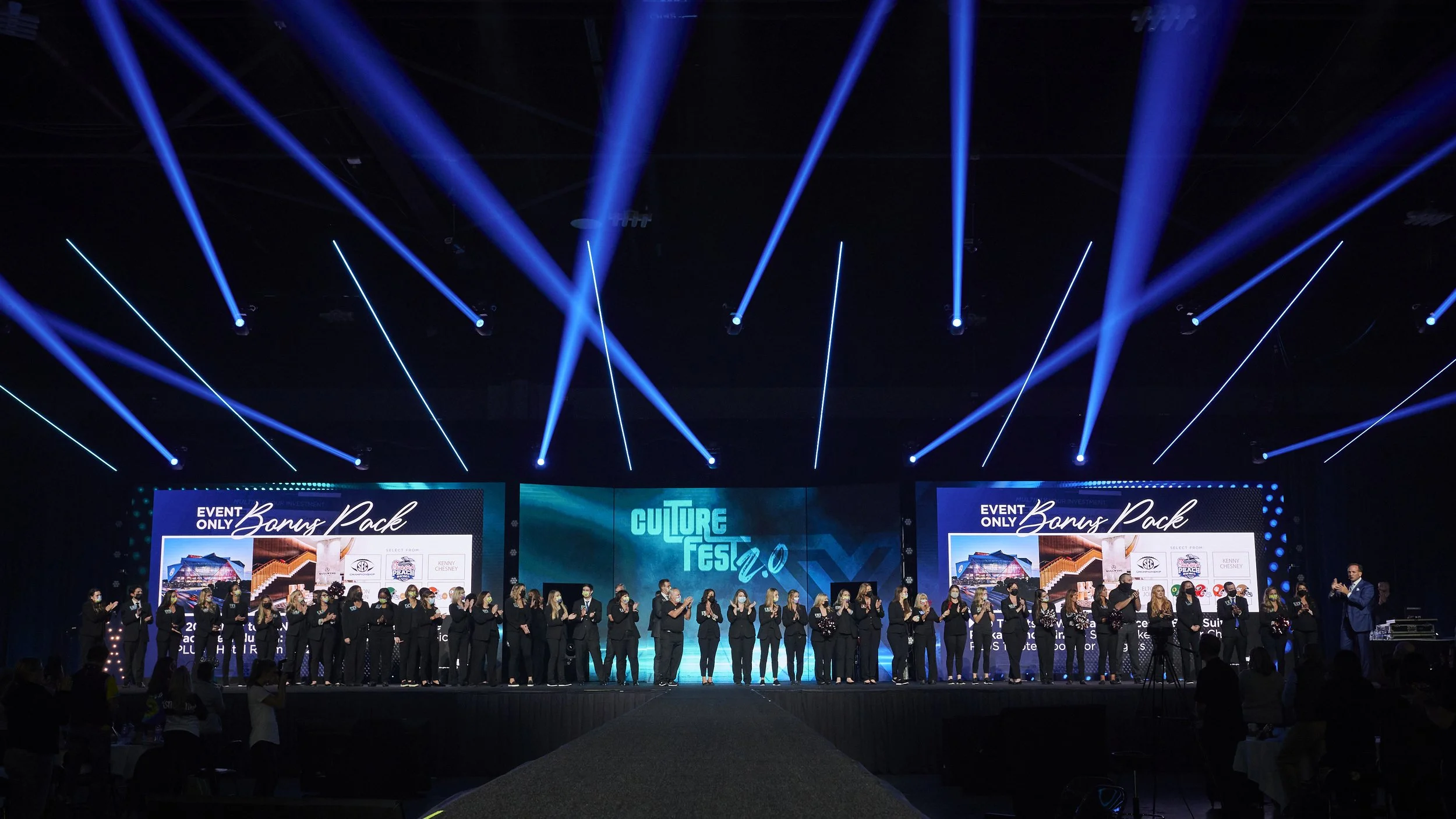
Corporate event lighting is almost always difficult. Blue or purple uplights set the atmosphere, the ambient room light may be warm or fluorescent, and spotlights illuminate the stage at yet another color temperature closer to daylight. Those sources compete in nearly every frame.
My approach is to keep exposure manual and white balance fixed at 5600 Kelvin. That doesn't magically correct mixed lighting, but it gives me a consistent starting point in Capture One. I can group photographs made under similar conditions and work through the corrections more efficiently. When I edit, skin tones come first. The goal is to document the people at the event, not deliver photographs in which everyone looks blue or purple because the room was lit that way.
Preparation Matters as Much as Equipment
Good event coverage begins before the event.
Clients are contractually required to provide a detailed shot list at least 72 hours before the event, identifying notable guests, keynote speakers, important moments, and specific details that need coverage. In practice, that list doesn't always arrive. An on-site contact may help identify people, but that person often has other responsibilities and may not be available when needed. Experience helps me recognize important moments, but it cannot tell me which guest is especially significant to a client if nobody identifies them. That's why the contractual requirement matters. It establishes clear expectations about the information the client must provide for complete coverage. A detailed shot list is as important to successful event photography as having the right equipment.
What I'd Recommend to Someone Starting Out
If I were starting over with a limited budget, I would buy a reliable camera body and invest in a good 24–70mm lens first. You will almost definitely need to invest in a hot shoe flash. Luckily there are a ton of budget friendly options here. This setup will cove the bulk of the more deliberate photographs, including VIP portraits, small groups, and atmosphere, which are often the images the client needs most. You can still photograph a keynote with that lens by planning your position carefully, capturing a variety of useful angles during the first two or three minutes, and then stepping away rather than spending the entire presentation distracting the room.
The equipment matters, but knowing when to engage and when to disappear matters just as much.
For more practical photography advice, equipment recommendations, and insight into my professional workflow, explore the Photography Guides & Resources collection.
Planning a corporate event in South Atlanta or the greater Atlanta area? Visit our Event Photography Services page to learn more about professional coverage for conferences, corporate gatherings, and special events.
studio@southatlantaphotography.com
Affiliate Disclosure: Some links in this article are affiliate links. If you purchase through them, I may earn a small commission at no additional cost to you. All equipment featured is gear I personally use in my professional photography work.